Lifecycle Marketing: The 8 Stages and the Flow for Each
What is lifecycle marketing?
Lifecycle marketing is sending each customer the message that fits where they are in their relationship with your brand, instead of sending everyone the same campaign. A shopper who left a cart on Thursday, a buyer waiting for their first delivery and a regular who has not ordered in two months need three different messages, on three different days.
The practical version is a set of automated flows, one per stage, each started by something the customer actually did.
The eight stages
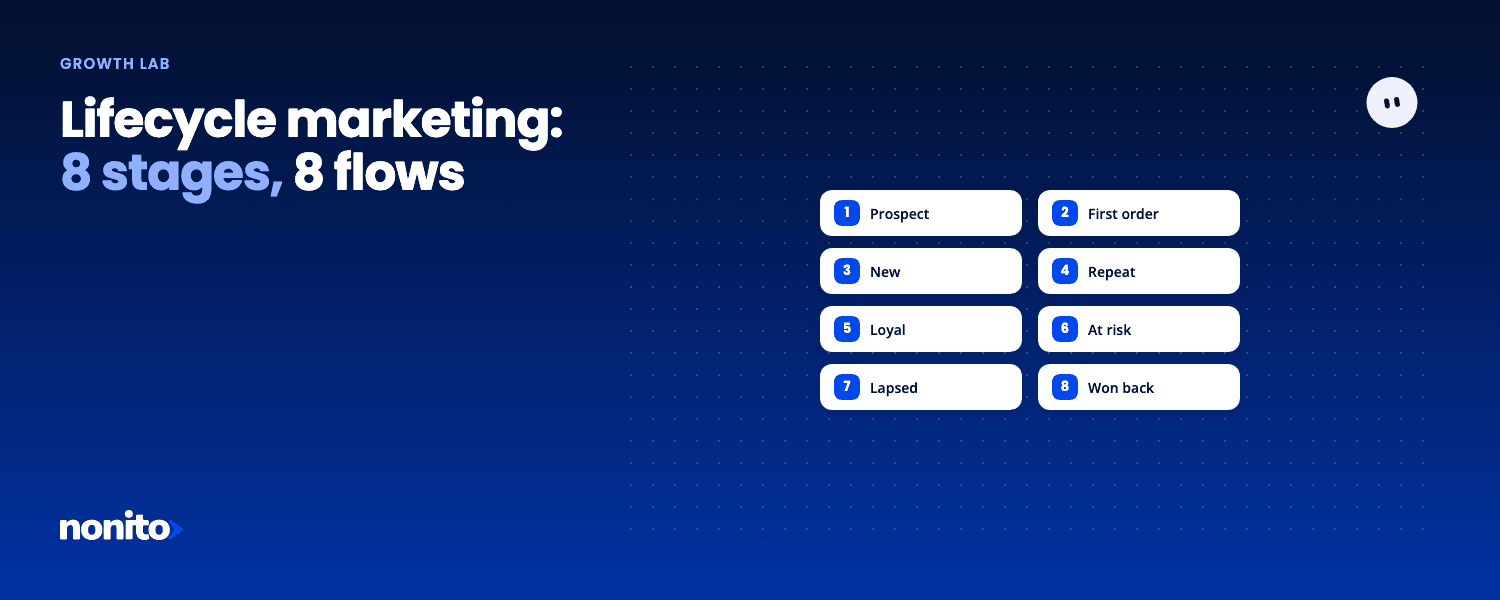
We use eight stages, the same ones Nonito's AI growth marketer Dome tracks for every brand:
| Stage | Who is in it | The job |
|---|---|---|
| Prospect | Visitors and walk-ins you can contact | Get the first order |
| First order | Someone who just bought | Make the first experience smooth |
| New | First 30 days after the first order | Earn the second order |
| Repeat | Bought more than once | Keep the rhythm going |
| Loyal | Buys regularly, worth the most | Recognise and reward |
| At risk | Late against their usual cycle | Catch them before they go |
| Lapsed | Stopped buying | Win them back |
| Won back | Returned after lapsing | Make it stick this time |
The flow for each stage
Prospect: capture and convert
For online stores the first flow is abandoned cart recovery: a WhatsApp message a few hours after checkout is left, linking straight back to the cart. On Nonito it has converted between 8.8% and 29.2% of shoppers reached, with half of recovered orders landing within 14 hours. For shops and restaurants, in-store opt-in turns a walk-in into a contact you can message.
First order: confirm and reassure
Order confirmation on WhatsApp lets the customer confirm, change or cancel before dispatch. Where cash on delivery is common, this flow pays for itself in refused deliveries avoided. Add shipping updates to cut "where is my order?" messages.
New: ask for the second order
This is where most brands lose people. Post-purchase feedback after delivery opens the conversation, and cross-sell suggests the natural next product.
Repeat and loyal: keep the rhythm
Back-in-stock alerts and referral work best here. Loyal customers are also the ones whose feedback you most want to hear.
At risk: act on the cycle, not the calendar
"Inactive for 90 days" is the wrong trigger. A customer who reorders every 20 days is at risk on day 40, while a furniture buyer is fine at day 200. Track each customer against their own purchase cycle. We cover how in RFM analysis and churn prediction.
Lapsed and won back: a reminder first, a discount second
A win-back flow starts with a plain reminder and keeps any discount for the second touch. Once a customer returns, treat them like a new customer again: the second order after a lapse is as fragile as the first.
A worked example: one customer through all eight stages
Sarah finds a Riyadh abaya brand on Instagram and adds two items to her cart. She leaves at the payment step.
- Prospect. Three hours later she gets a WhatsApp message with a link back to the same cart. She orders that evening.
- First order. A confirmation arrives straight away with buttons to confirm or change the address. She fixes her building number.
- New. Two days after delivery she is asked for a rating. She gives five stars. A week later she sees the matching scarf.
- Repeat. She orders again before Eid. Her usual gap between orders is now known: about six weeks.
- Loyal. After her fourth order she gets early access to the new collection.
- At risk. Ten weeks pass with no order, almost two cycles late. She gets a short, friendly reminder in Arabic.
- Lapsed. No reply. Three weeks later, one last message with an offer inside the brand's discount limit.
- Won back. She orders. The welcome sequence starts again, because the next order after a lapse is the hardest one to earn.
Every message was triggered by something Sarah did, or stopped doing. None was a campaign to the whole list.
Common mistakes
- Using one inactivity threshold for everyone. Customers buy at different rhythms. Act on each one's own cycle.
- Skipping the second order. Brands build welcome and win-back flows and forget the stage that decides whether a customer comes back at all.
- Discounting too early. A discount in the first reminder teaches customers to wait for one.
- Measuring sends instead of orders. A flow that sends thousands of messages and brings in no orders is not working.
Where to start
You do not need eight flows on day one. Start with the three every commerce brand should run: order confirmation, abandoned cart recovery and post-purchase feedback. Then add one stage at a time, starting with the one that leaks the most.
Finding that leak is the hard part. It is exactly what Dome, Nonito's AI growth marketer, reports every week: how many customers sit in each stage, which flows reach them, and where nothing does.
Frequently asked questions
What are the 5 stages of the customer lifecycle?
The common short version is reach, acquisition, conversion, retention and loyalty. The eight stages above split retention into the moments that need different messages: new, repeat, at risk, lapsed and won back.
What is the difference between lifecycle marketing and email marketing?
Email marketing is a channel. Lifecycle marketing is a strategy that can use any channel. In MENA, WhatsApp usually carries most lifecycle messages; see our WhatsApp lifecycle guide.
How many flows does a brand need?
Three to start: order confirmation, abandoned cart and post-purchase feedback. Most brands add one stage a month after that.