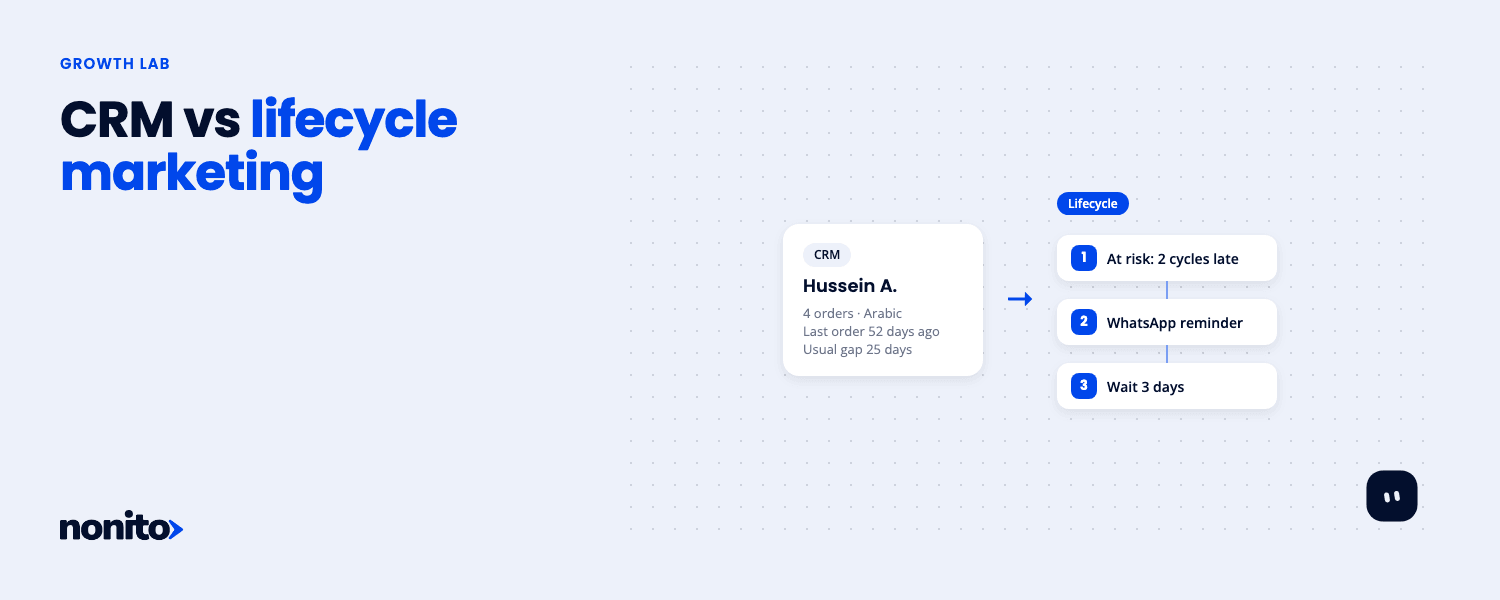
CRM vs Lifecycle Marketing: What Is the Difference?
The short answer
A CRM is a system that stores what you know about your customers: who they are, what they bought, what they said. Lifecycle marketing is the practice of using that knowledge to send each customer the right message at the right stage of their relationship with you. One is a record. The other is an action.
A brand can have a CRM full of customers and do no lifecycle marketing at all. That is the most common situation we see.
How they differ
| CRM | Lifecycle marketing | |
|---|---|---|
| What it is | A database of customers and interactions | A set of messages triggered by customer behaviour |
| Main question | What do we know about Hussein? | What should Hussein hear from us today? |
| Owned by | Sales, support or operations | Marketing |
| Output | A profile | A message, and an order it led to |
| Measured by | Data completeness | Repeat rate, revenue attributed |
Why a CRM alone does not grow repeat orders
Take Farida, who runs a skincare brand on Shopify. Her customer list holds 9,000 people with phone numbers. Every one of them has a purchase history. None of them hears from her unless she sends a campaign to the whole list, which happens before Ramadan and White Friday.
Her CRM is not the problem. Nothing reads it. Lifecycle marketing is the layer that watches the record and acts on it: an abandoned checkout starts a reminder, a delivery starts a feedback request, a regular who is late starts a win-back.
How they fit together
The best setup is one where the two are the same system, so the message and the record never drift apart:
- The store sends orders, carts and customers into one profile per customer.
- Each event can start a flow on WhatsApp, SMS or email.
- Every reply and every order lands back on the same profile.
- Orders that follow a message are attributed to the flow that sent it.
That loop is how Nonito works. If your CRM is an ERP like Odoo, see how to turn Odoo into an omnichannel CRM.
The five CRM stages a brand moves through
We describe maturity in five stages. Dome, Nonito's AI growth marketer, works out which one a brand is in from its own data:
- Connected. Store or POS connected, customers and orders flowing, one channel live.
- Basics. Welcome, abandoned cart and order confirmation running.
- Retention. Post-purchase and win-back flows live, audiences in use, a campaign in the last 30 days.
- Optimising. A feedback loop, flows reviewed against results, more than one channel in use.
- Orchestrated. Journeys across channels, personalised by audience, with results measured per change.
Most brands with a CRM sit at stage zero or one. Each step up is a lifecycle marketing step, not a CRM purchase.
Signs you have a CRM but no lifecycle marketing
- Customers only hear from you during sales seasons.
- Everyone on the list gets the same message, in the same language.
- Nobody can say how many customers are due a second order this week.
- Abandoned checkouts sit in the store with no follow-up.
- You cannot tie a single order to a single message.
If three or more of these are true, the gap is not data. It is the layer that acts on it.
Do you need a separate CRM for lifecycle marketing?
Usually not. A commerce brand's real customer record is its store: Shopify, Odoo, Foodics or a custom system. What lifecycle marketing needs is that record flowing into a tool that can trigger messages, with replies and orders coming back. Buying a sales CRM on top of that often adds a second, out-of-date copy of the same customers.
The exception is B2B or high-touch sales, where account managers need a pipeline. For a D2C brand or a restaurant, a unified customer profile inside the messaging platform covers both jobs.
What changes when the two are joined
Farida from the example above connected her store and switched on three flows. Within the first week:
- Abandoned checkouts got a WhatsApp reminder within hours instead of nothing.
- Every new order got a confirmation with buttons to fix the address.
- Delivered orders got a feedback request, and the bad reviews reached her the same day.
Her customer records did not change at all. What changed is that something now reads them.
What to do first
If you already have customer data, you do not need a new CRM to start lifecycle marketing. You need the first three flows: order confirmation, abandoned cart and post-purchase feedback. Read the eight lifecycle stages and the flow for each, or let Dome tell you which stage you are in and what is missing for the next one.
Frequently asked questions
Is lifecycle marketing part of CRM?
They overlap. Some teams call lifecycle marketing "CRM marketing" because it runs on CRM data. The useful distinction is that a CRM holds the data and lifecycle marketing turns it into messages.
Who owns lifecycle marketing in a small brand?
Usually the founder or a marketer of one. That is why automation matters: the flows run whether or not anyone has time that week. See what a lifecycle marketing manager does.
Which CRM works best with Shopify?
For lifecycle work, the one that reads Shopify natively and can message on the channels your customers use. In MENA that means WhatsApp first, with SMS and email alongside.