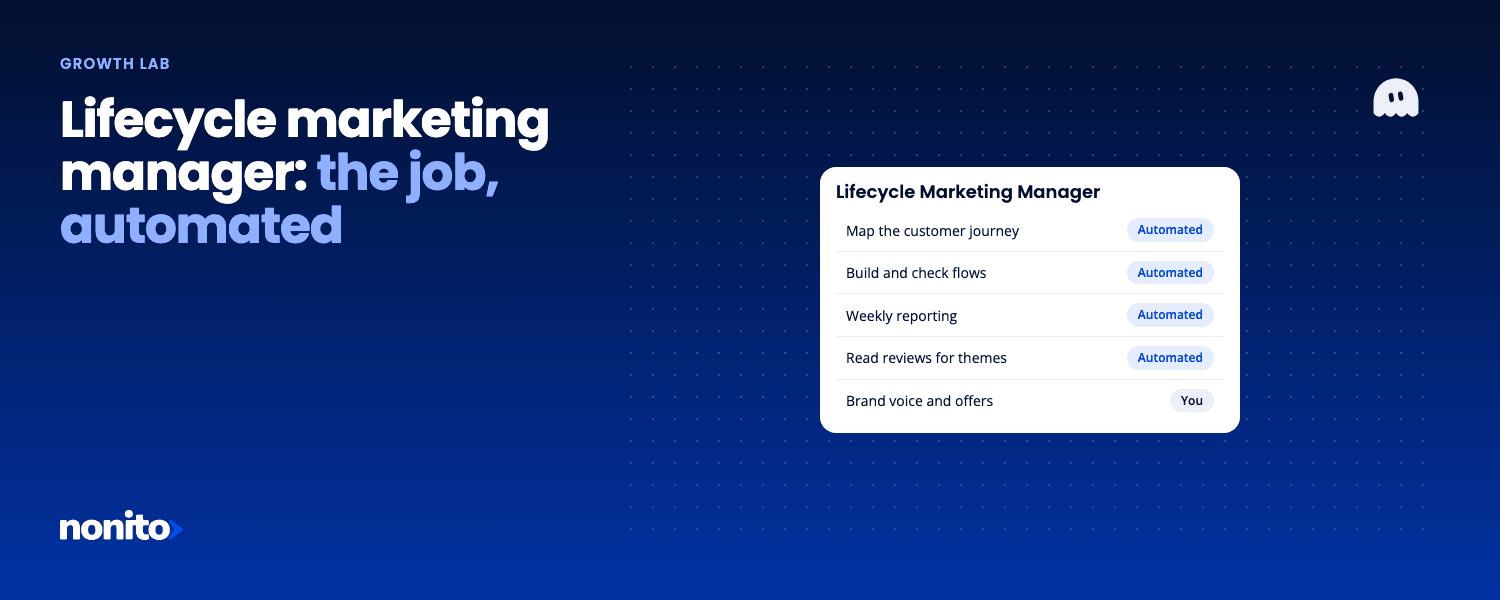
Lifecycle Marketing Manager: Job Description and What to Automate
What a lifecycle marketing manager does
A lifecycle marketing manager owns everything that happens after a customer's first order: onboarding, the second purchase, loyalty and win-back. In practice that means segmenting customers, planning the messages each group should get, building the automations that send them, and measuring what each one earns.
It is one of the highest-return marketing roles in an ecommerce brand, because it works on customers you have already paid to acquire.
Job description you can copy
About the role
We are looking for a Lifecycle Marketing Manager to turn our first-time buyers into repeat customers. You will own our customer journey from first order to loyalty, across WhatsApp, SMS and email, in Arabic and English.
Responsibilities
- Map our customer journey and find where customers drop off between first and second order.
- Build and maintain automated flows: order confirmation, abandoned cart, post-purchase, cross-sell and win-back.
- Define and maintain customer audiences based on purchase behaviour and lifecycle stage.
- Plan and run campaigns for key seasons such as Ramadan, Eid and White Friday.
- Report weekly on repeat rate, revenue attributed to flows and campaign results.
- Run tests on timing, channel and offer, and roll out what works.
- Read customer feedback and reviews, and turn recurring themes into fixes.
Requirements
- Two or more years running retention or CRM marketing for an online brand.
- Hands-on experience with a marketing automation tool and WhatsApp Business messaging.
- Comfortable with spreadsheets and basic customer analysis such as cohorts and RFM.
- Fluent written Arabic and English.
What success looks like after six months
- The core flows live and reviewed monthly.
- A repeat rate that is tracked weekly and moving.
- Every flow and campaign reported with the orders it brought in.
Skills that matter more than tools
Tools are learnable in a week. Hire for these instead:
- Curiosity about customers. Reading replies and reviews, not just dashboards.
- Comfort with numbers. Knowing the difference between a flow that sends a lot and a flow that earns.
- Restraint. Knowing when not to send. Two abandoned cart messages, not five.
- Writing in two languages. Arabic copy written for Arabic readers, not translated from English.
Which parts of the job you can automate
Split the responsibilities above into thinking work and repeat work, and a large share turns out to be repeat work.
| Responsibility | Can be automated? |
|---|---|
| Finding where customers drop off | Yes, computed nightly from store data |
| Building and checking standard flows | Yes, with human approval |
| Building audiences from behaviour | Yes |
| Weekly reporting | Yes |
| Reading feedback for themes | Yes, with same-day alerts for bad reviews |
| Seasonal campaign strategy | Partly: drafted, but the offer is your call |
| Brand voice and offer limits | No |
| Managing agencies and people | No |
This is the work Dome, Nonito's AI growth marketer, does: he keeps a brand file, writes weekly insights from your data, and builds flows that wait for your approval.
Interview questions that reveal the right person
- "Walk me through a flow you built that did not work." Good candidates talk about what the numbers showed and what they changed.
- "Our repeat rate is flat. What do you look at first?" Listen for the second order, purchase cycles and which flows reach which customers, not "a big campaign".
- "How would you decide when to send a win-back message?" Strong answers mention each customer's own buying rhythm, not a fixed number of days.
- "Rewrite this English message for an Arabic-speaking customer." You will learn more from this than from any portfolio.
The first 90 days
- Days 1 to 30. Map the journey, audit live flows, and switch on order confirmation, abandoned cart and feedback if they are missing.
- Days 31 to 60. Build the second-order and win-back flows. Set up weekly reporting on repeat rate and attributed revenue.
- Days 61 to 90. Run the first tests on timing and offer, and plan the next seasonal campaign from the customer data, not last year's calendar.
If an AI growth marketer has already done days 1 to 60, the new hire starts at day 61.
Hire, automate, or both?
For a brand with a marketing team of one or two, automating first usually makes sense: the core flows get built in days, and the weekly analysis happens without anyone finding time for it. Hire when retention becomes big enough to need someone who sets strategy, manages people and owns brand decisions. That person then gets an analyst and builder from day one.
See the full comparison in Dome vs hiring a lifecycle marketer, or read what an AI growth marketer is.
Frequently asked questions
What is the difference between a lifecycle marketer and a CRM marketer?
In most companies they are the same role with different names. Both own messaging to existing customers based on their behaviour.
Should the role sit in marketing or customer service?
Marketing, with a close line to customer service. The lifecycle marketer needs to hear what customers complain about, because that is where the next fix usually comes from.
Is this a full-time role for a small brand?
Often not at first. Once the core flows are built, the weekly work is analysis and tuning, which is the part that automates best.